
Lapis lazuli is a deep-blue metamorphic rock prized for millennia as a gemstone, pigment source, and ornamental stone. Its intense ultramarine color and often-gold flecking make it instantly recognizable. Lapis is not a single mineral but a rock composed of several minerals, primarily lazurite, with calcite, pyrite, and sometimes other accessory minerals.
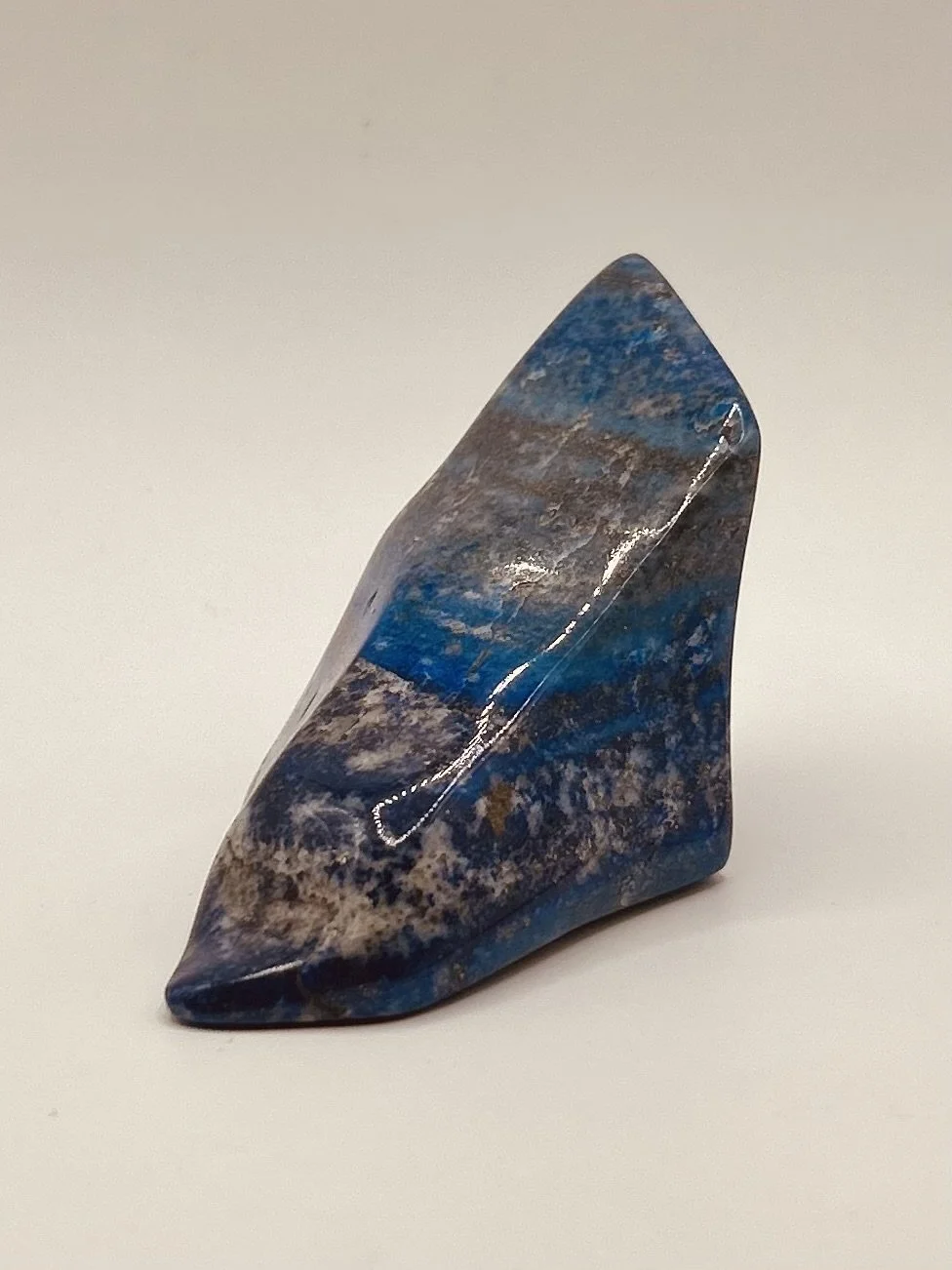
Chunk of Lapis Lazuli
Material and Composition
Primary mineral: Lazurite (A calcium sulphate) gives it it’s blue appearance.
Common accessory minerals:
Pyrite (iron sulfide) — produces metallic, gold-colored flecks that many collectors and artisans prize. (Pyrite is also known as “Fools Gold”)
Calcite (calcium carbonate) — appears as white streaks or patches; high calcite content can reduce translucency and color intensity.
Sodalite, hauyne, and diopside — may be present in smaller amounts and can influence tone and texture.
Texture: Typically, coarse grained. The blue color is generally opaque when high-quality.
Variants: “Banded” or “streaked” lapis shows visible calcite veins; “ultramarine grade” lapis is intensely blue with minimal calcite and attractive pyrite.
Hardness and Durability
Mohs hardness: About 5 to 5.5 (Varies)
Durability considerations:
Soft compared to quartz and many gemstones — susceptible to scratching and abrasion.
Sensitive to acids and some chemicals (calcite component reacts more readily).
Avoid ultrasonic cleaners and steam cleaning; both can damage lapis.
Best care: clean with a soft cloth and mild soapy water, then rinse and dry. Store separately from harder gemstones to prevent scratching.
Sources and Occurrence
Historical and primary sources:
Afghanistan (Sar-e-Sang, Badakhshan region) — ancient and historically the most prized source, producing deep ultramarine lapis used since antiquity.
Chile — produces lapis with slightly different hues, often more variable in quality.
Russia (Lake Baikal region) — known source with its own distinctive material.
Other occurrences, such as parts of the United States and Pakistan, other parts of southeast Asia as well.
History and Cultural Significance
Ancient use: Mined and traded at least as far back as 7th millennium BCE. Lapis was used in Mesopotamia, Egypt, the Indus Valley, and later throughout the Mediterranean.
Egypt: Highly valued by the pharaohs; used in jewelry, amulets, inlay, and powdered for cosmetics and burial items (including inlays in the mask of Tutankhamun).
Mesopotamia and Persia: Employed for carved seals, beads, and ornamental objects.
Medieval and Renaissance Europe: Ground into ultramarine pigment — the finest blue used by painters, reserved for the most important subjects (notably the robes of the Virgin Mary) because of its expense. Ultramarine pigment (lazurite-based) rivaled and often exceeded the value of gold.
Symbolism: Associated with royalty, truth, wisdom, and protection in various cultures.
Uses Today
Jewelry: Cabochons, beads, inlays, and carved pieces. Preferred settings protect the stone’s surface (bezels rather than prongs).
Decorative arts: Boxes, mosaics, intarsia, and sculptures.
Pigment: Historically converted into ultramarine pigment by grinding and complex extraction; synthetic ultramarine largely replaced natural ultramarine in modern painting and industry.
Collecting: High-quality, evenly deep-blue stones with minimal calcite and attractive pyrite are most valued.
Grading and Quality Factors
Color: Most important attribute. Intense, uniform deep blue with slight violet undertone is highest grade.
Tone and saturation: Even saturation preferred; too light (pale blue) or too dark (near-black) reduces desirability.
Inclusions: Fine, evenly distributed pyrite can enhance appearance; large clusters or brassy overabundance can be distracting. Visible white calcite veins lower grade.
Cut and finish: Polished cabochons and beads are common; lapidary work aims to maximize color while minimizing the visibility of calcite.
Imitations and Treatments
Common imitations: Dyed howlite, dyed magnesite, glass, and plastic. Look for overly uniform color, dye concentrations in cracks, or unrealistic translucency.
Treatments: Dyeing is common to enhance pale material. Stabilization with resins can improve durability but should be disclosed.
Testing: Visual inspection for pyrite and Calcite (Use a UV Flashlight for to check for Fluorescence)
